Manual methods for quality assurance can no longer keep up with the volume and complexity of customer interactions.
Contact center leaders are well aware of this: our new report in partnership with Call Centre Helper, What Contact Centers Are Doing Right Now, shows that 44% of contact center professionals want to adopt auto or real-time QA.
Automated and AI-powered quality assurance can increase accuracy and efficiency while reducing costs and time. So why wouldn’t a contact center invest in this?
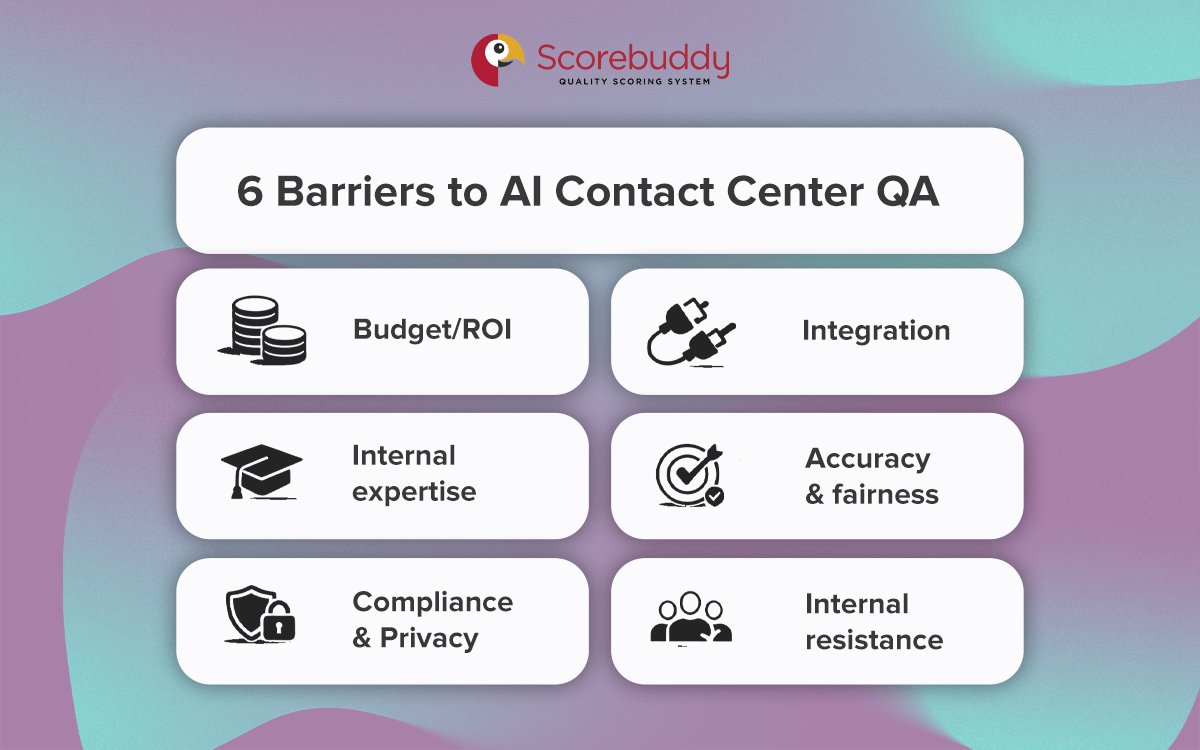
Despite the clear benefits of an AI contact center quality assurance program, widespread adoption is still lagging. Many contact centers hesitate to implement AI due to challenges such as budget, accuracy, security concerns, and a lack of internal expertise.
While these concerns are valid, you can overcome them with the right strategy.
In this article, we’ll explore the 6 biggest barriers to AI contact center QA and practical steps to solve each.
 #1. Limited budget and ROI concerns
49% of survey respondents said that budget was their top barrier to implementing AI in their QA program. (What Contact Centers Are Doing Right Now)
Budget limitations make it hard to justify investing in AI, especially when ROI is not always clear. This is not surprising, as contact centers don’t often have expansive budgets to invest in new tech.
The AI overwhelm is real, too. With the recent explosion of AI-powered tools, it can feel impossible to narrow down which one your contact center actually needs.
AI-powered tools, like a QA platform, are often not just a one-time fee, but rather structured as ongoing licensing or subscription fees. Training time for agents and QA teams can also add to the cost.
You don’t need to automate everything, nor should you. If you are to choose one AI-powered tool, let it be quality assurance. AI-QA analyzes 100% of customer interactions, rather than just a small sample, saving time and labor.
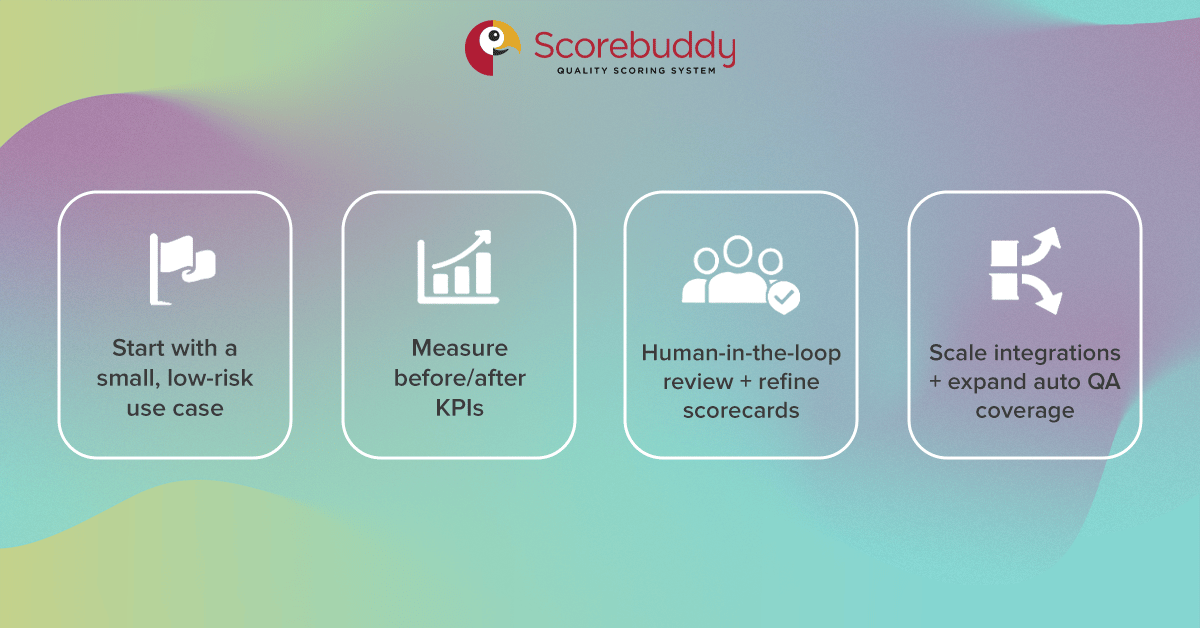
Start with a controlled pilot of one team or channel to get results without over-committing budget. A pilot lets you compare AI-QA performance against your existing manual processes, and capture data around time saved, accuracy improvements, and operational efficiency.
Use baseline data from your manual QA process and compare it directly with results achieved through AI-QA, tracking metrics like cost-to-score, QA coverage, and scoring variance.
By linking AI-QA results to measurable business impact like efficiency, CX, compliance, and retention, you build a clear, compelling narrative that AI-QA is not just a QA upgrade but a revenue and cost-optimization tool.
When using a tool like AI auto scoring for QA evaluations, contact center managers see tangible ROI, including:
|
Before (Manual QA) |
After (AI-QA) |
The Impact |
|
|
QA coverage |
Limited sampling (only 2 or 3% of interactions reviewed) |
Up to 100% of conversations scored automatically |
70%+ increase in QA coverage |
|
Cost-to-score |
High (labor-intensive evaluations, inconsistent throughput) |
Lower (automation reduces manual effort + improves efficiency) |
90%+ reduction in cost-to-score |
|
Workload |
Heavy workload for evaluators (scoring and admin) |
Less manual scoring means evaluators focus on calibration/coaching |
60%+ reduction in manual QA workload |
|
Time-to-score (per interaction) |
Hours, or even days depending on backlog |
Near real-time scoring and feedback loops |
<5 seconds average AI scoring time |
39% of contact centers reported that a lack of internal expertise was their main barrier to implementing AI in their QA program. (What Are Contact Centers Doing Right Now)
Ideally, when implementing a new technology or tool into a contact center, someone on the team has some working knowledge of it. This, as demonstrated by our report, is clearly not always the case with incorporating AI into QA.
If you’ve invested AI contact center QA, that shouldn’t be the last interaction you have with the company. Look to buy from companies that offer after-purchase support and help your team adjust to the new platform.
This tool is connected to operations, QA, IT, training, compliance, and leadership teams, so a special AI team composed of members from each can ensure it is successfully implemented and maintained.
Learning to master a new AI-powered tool is a valuable asset in today’s job market.
There will likely be many team members who are interested and eager to be trained on using AI contact center QA.
According to McKinsey, demand for AI fluency has grown sevenfold in two years, making it the fastest-rising skill in U.S. job postings. Upskilling your staff with AI experience sets them up for long-term success and growth.
Download the contact center QA report now
33% of respondents reported that integration with existing tools was their biggest barrier to implementing AI in their QA program. (What Are Contact Centers Doing Right Now)
Contact centers already have existing tech stacks, and integrating a new tool shouldn’t make a mess of the systems in place. Tools that don’t integrate correctly can cause miscommunications, workflow disruptions, and data silos.
Integrate only the essential systems first, the ones you must connect for AI-powered QA to work. Connecting the primary data sources, like call recordings and basic metadata, ensures the AI-QA system can start scoring and generating insights right away.
Don’t make more work and choose a closed system. AI-QA with open APIs lets your CCaaS platform, CRM, and WFM systems exchange data seamlessly.
For example, an API can let an AI-QA platform pull call recordings from your CCaaS or push QA scores back into a dashboard your team already uses.
Most contact centers already have a system of existing tools and platforms, including popular options such as Intercom, Genesys, Amazon Connect, Salesforce, Freshdesk, Zendesk, LiveChat, and more.
Whichever AI tool you choose, ensure it offers seamless integration with what you already have, and that the support team can assist if any issues arise.
23% reported that the biggest barrier to implementing AI in their QA program was concerns about the fairness and accuracy of AI. (What Contact Centers Are Doing Right Now)
Some AI tools, such ChatGPT, have been known to make glaring errors when it comes to accuracy and bias. Naturally, this has led to skepticism around AI in certain contexts, like making decisions that impact agents.
Compare manual quality assurance scoring to AI scoring to demonstrate accuracy and consistency.
AI can do a lot, but it shouldn’t do everything. In the AI-QA process, humans are needed for calibration, compliance, and ultimately, decision-making.
One of the benefits of AI contact center quality assurance is that it is consistent, accurate, and unbiased. But that doesn’t mean that there won’t be situations in which agents feel that the way a scorecard was graded was unfair.
Having a process to appeal scorecard ratings can support agents when they feel as if their actions were correct despite a low QA score.
When you monitor how AI scores different groups, you can identify and correct patterns of bias or inconsistency early.
AI won’t be perfect right away; AI scoring models improve when they’re exposed to more real data from your agents, channels, and customer interactions. With regular fine-tuning, AI scoring can be aligned with updated policies and scorecards.
According to research from the University of Melbourne and KPMG, only 46% of respondents trusted the use of AI systems. Therefore, the accuracy of AI systems is crucial for getting the team on board, look for 90%+ AI scoring accuracy.
21% reported that the biggest barrier to implementing AI in their QA program was concerns regarding compliance and privacy risks. (What Contact Centers Are Doing Right Now)
AI systems often require access to sensitive customer data like call recordings, transcripts, and account details. Therefore, contact center AI compliance must be a priority; any AI tool used must meet strict regulatory requirements and industry-specific rules that define how data is stored, processed, and transmitted securely.
If an AI system isn’t fully compliant, it can expose the organization to legal risks, fines, and reputational damage.
Before implementing AI, contact centers should identify exactly what data the system will access, where it will travel, and how it will be stored. This mapping helps uncover potential privacy risks early and ensures all sensitive information is handled appropriately.
Limiting who can access AI outputs and underlying data prevents misuse and strengthens compliance. A formal governance framework also defines how AI decisions are monitored, audited, and corrected to ensure ongoing fairness and safety.
Choosing AI vendors with rigorous security certifications ensures the AI platform meets industry-recognized standards for data protection. This reduces risk and gives internal stakeholders confidence that the technology is secure and compliant.
Look for AI vendors that are ISO 27001:2022 certified and SOC 2 Type 2 compliant.
18% reported that resistance from staff and stakeholders was the biggest barrier to implementing AI in their QA program. (What Contact Centers Are Doing Right Now)
A common concern surrounding AI is that it will replace humans in their jobs. There may be worry that automation may devalue expertise and threaten job security. Even if AI is designed to make the jobs of humans easier and more efficient, contact center AI QA adoption may be slow.
This can give agents peace of mind that they’re not being replaced or losing control.
Take team member worries seriously, and address them directly. Offer the opportunity to have an open discussion around the implementation of AI to dispel fears.
AI shouldn’t be a replacement in quality assurance but rather an enhancement. It will provide more accurate coaching for managers and better development for agents.
According to research from MIT, on average, the combination of humans and AI outperformed the baseline of humans acting on their own. This doesn’t mean humans should be replaced, but rather that AI can do a lot of the heavy lifting for repetitive, low-risk tasks.
Agents and leaders remain the decision-makers, and AI tools should support this “human-in-the-loop” model, letting humans and AI play to their strengths.
Want a deeper look at AI-QA blockers? Watch the webinar: What Contact Centers Are
For a full, in-depth guide to implementing AI quality assurance in your contact center,
download our AI call center QA playbook.
 Get ready to scale quality assurance with AI
Manual quality assurance struggles to keep pace in the modern-day contact center, so the need and demand for AI contact center QA are there.
Yet barriers around implementing AI quality assurance exist: Concerns around trust, accuracy, integration, compliance, and change management are all valid, especially in complex, highly regulated contact center environments.
However, when contact centers take a phased, human-in-the-loop approach and align AI initiatives with clear business goals, these challenges become manageable rather than prohibitive.
With the right technology, governance, and internal adoption, AI-powered QA can move from a perceived risk to a strategic advantage, enhancing consistency, improving coaching outcomes, and delivering measurable ROI at scale.
With AI Auto Scoring, advanced reporting, and integrated coaching, Scorebuddy enables teams to review up to 100% of interactions, accelerate feedback loops, and transform QA from a cost center into a strategic growth driver.
Download the report: What Contact Centers Are Doing Right Now.