Today’s contact centers depend on more than just call recordings and post-interaction surveys. Every conversation holds valuable insights about customer needs, agent behaviors, overall quality of service, and more.
But a huge chunk of that information goes untapped. Traditional call center quality assurance methods capture only a small fraction of interactions, making it difficult for managers to get the full performance picture.
This is why many contact center leaders are now turning to conversation intelligence software to add depth to their QA programs.
By using artificial intelligence (AI) to analyze every customer interaction, you can uncover patterns, pinpoint coaching opportunities, and understand CSAT drivers. This expands coverage and brings deeper insights than QA alone.
In this article, we’ll cover what conversation intelligence software is, how it adds to contact center QA, and what you should look for in a CI solution.
Conversation Intelligence goes beyond transcription and uses AI to analyze the full context of a conversation, including sentiment, intent, behavior patterns, and more across omnichannel interactions.
Powered by AI and machine learning, it uncovers what’s happening in calls, texts, emails, and more—both on the surface and between the lines—surfacing trends and patterns in those conversations. It takes unstructured data and turns it into a CX story.
For contact center managers, it’s a way to surface patterns in agent performance, customer sentiment, and process gaps without having to manually review thousands of calls.
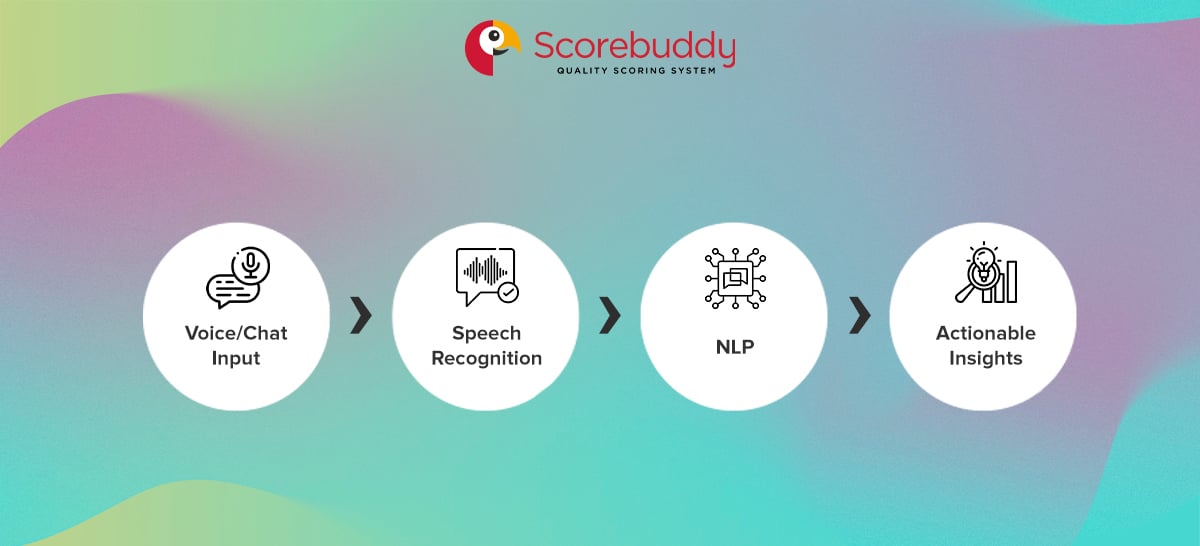
At its core, conversational intelligence software relies on speech recognition and natural language processing (NLP):
This combination allows managers to analyze 1,000s of conversations in seconds, rather than relying on tiny sample sizes and subjective scoring.
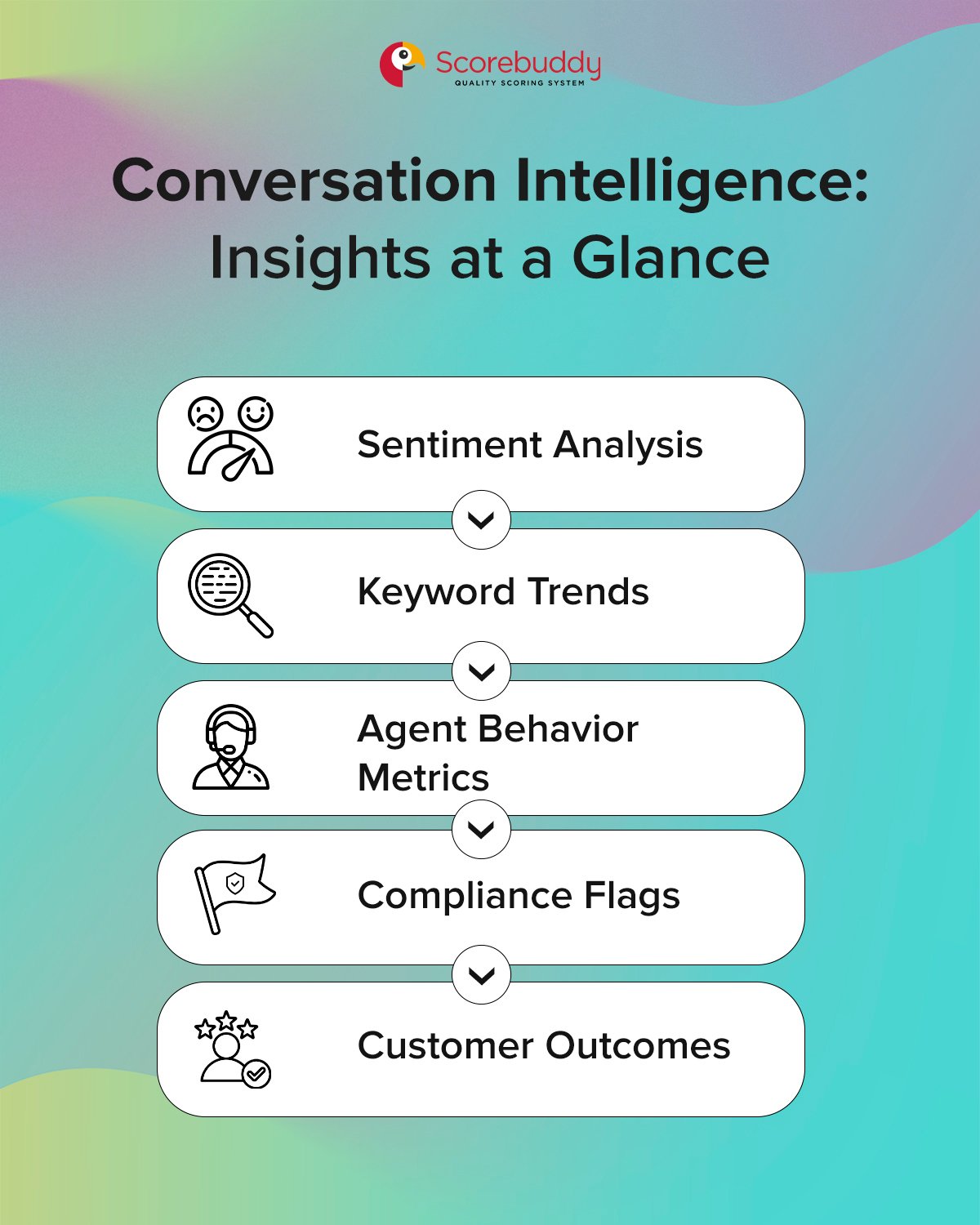
It detects customer frustration, agent empathy, compliance lapses, and more, for deeper voice of the customer (VoC) insights.
 And some systems go even further by identifying trends across teams, flagging common objections, or revealing the root causes of negative feedback through AI analytics.
These insights help pinpoint where training, scripting, or process changes make the biggest impact.
Conversation intelligence can capture and analyze:
It works in both real time or after the interaction, depending on the software.
With the ability to analyze omnichannel conversations, the software’s AI models learn more about your specific customer base, refining accuracy and context over time. That means less time spent guessing and more time spent acting on real customer insights.
See how Scorebuddy delivers conversation analytics with AI and automation.
Conversational intelligence software is reshaping how contact centers measure and improve performance. It does not replace core customer service metrics like CSAT score, FCR, or AHT, but strengthens them by giving real visibility into what actually drives those numbers.
Traditional quality monitoring relies on random call sampling, which can miss recurring issues or standout moments—not to mention only covering a small fraction of your total interactions.
 CI analyzes every conversation, revealing trends that connect directly to performance goals. You can rely on more than just manual quality assurance reviews, acquiring a complete perspective on agent actions, customer demands, and operational difficulties.
Because it’s tied to all interactions, conversation intelligence platforms give insights into both service and strategy. These findings help pinpoint where performance improves, where customer friction builds, and what’s influencing CX most. For example:
Beyond uncovering issues, conversation intelligence shifts how managers approach quality as a whole.
Instead of reacting to problems after they’ve affected customers, management can spot red flags and take action early.
By recognizing the patterns they form, they can adjust workflows, refine training, or support agents before performance dips.
This proactive model transforms QA from a reporting and coaching tool into a strategic advantage.
Managers no longer have to wait for low QA scores or negative surveys to understand what’s happening.
With conversational intelligence, they can:
Let’s look at an example use case for conversational intelligence in the contact center.
Say you’re seeing a spike in escalated calls. Obviously, you’ll want to find the cause so you can fix it. With conversation analytics software, you could analyze every single call escalation and identify the underlying patterns.
You might, for example, note a strong correlation between escalations and low agent talk-listen ratios during billing disputes.
In this scenario, you could then run targeted coaching sessions focused on active listening to reduce the number of escalations arising from these billing calls.

Conversational intelligence software has grown rapidly, with several established platforms leading the way. While this isn’t an exhaustive list, here are some of the most popular solutions on the market today.
Many of these tools are standalone CI solutions, and the ease of integration within your QA system may vary considerably.
Gong turns conversations into business insights. Originally popular with sales teams, it’s also used in service and support teams to analyze call quality and performance trends.
Their platform provides an extensive view of communication data, helping managers understand what drives successful sales calls and meetings, and identify patterns that impact customer satisfaction.
Key features include:
CallMiner provides deep interaction analytics for large-scale contact centers. It focuses on uncovering customer intent, emotional tone, and operational bottlenecks through conversation data.
Its strength lies in its ability to translate vast amounts of unstructured data into clear insights that link directly to performance outcomes and customer experience improvements.
Key features include:
Chorus helps organizations capture and analyze customer conversations to improve communication strategies and customer engagements. It’s widely used for customer success and sales conversations, and stands out for an emphasis on collaboration.
Their conversational intelligence software makes it easy for teams to share call insights, highlight successful sales strategies, and refine messaging across departments.
Key features include:
Balto focuses on real-time conversation guidance, helping agents respond accurately and confidently while on calls. It’s designed to support coaching in the moment instead of after an interaction.
By listening to conversations live, Balto provides contextual prompts and suggestions that help agents stay compliant, empathetic, and effective while maintaining a natural flow with customers.
Key features include:
We’ve only covered a few solutions here, leaving out the likes of Otter.ai, HubSpot Sales Hub, Fathom, and plenty more. To explore the best conversation intelligence software, check out the G2 reviews.
Conversation intelligence can live in two different environments within a contact center’s tech stack:
Both aim to uncover insights from customer interactions, but they differ in how they operate, integrate with your QA program, and influence daily workflows. Understanding how each approach functions helps managers decide which setup best supports their operational goals
|
Standalone Conversation Intelligence |
CI Integrated Into a QA Platform |
|
|
Workflows |
Operates as a separate analytics environment. QA teams must manually sync insights to scorecards/coaching. |
Fully unified. Insights flow directly into evaluations, coaching, and reporting. |
|
Analytics Depth |
Often deeper and broader (topic modeling, emotion detection, cross-department insights, etc.) |
Highly relevant to agent performance and QA metrics. May be narrower in non-QA use cases. |
|
Integrations |
Requires API/ETL setup to connect with recording systems, CRM, WFM, BI tools. |
Built-in links to QA, coaching, and reporting modules. Fewer integration points to maintain. |
|
Adoption & Ease of Use |
Requires analysts and supervisors to manage new dashboards and workflows. |
Faster adoption. Teams stay in their familiar QA environments with CI layered in. |
|
Compliance & Security |
Varies by vendor. Strong CI tools offer PII redaction, data governance, and enterprise controls. |
QA platforms typically enforce strict access controls tied to evaluation roles and teams. |
|
Total Cost of Ownership (TCO) |
Higher due to additional contracts, integrations, admin workload, etc. |
Lower. One platform, unified data model, reduced training + maintenance overhead. |

A standalone conversational intelligence solution works as a dedicated analytics platform focused on interaction data. It typically offers deep speech analytics, topic detection, and sentiment tracking across phone calls, chats, and messages.
These systems are often chosen for their advanced AI models and ability to provide a wide range of insights across departments, from customer experience to product feedback.
Built-in CI within a QA platform, on the other hand, combines conversation analytics directly with agent evaluation and performance workflows. This setup allows supervisors to move seamlessly from identifying insights to scoring interactions and coaching agents all in one place.
This integration reduces manual data transfers and creates a unified view of agent performance across metrics and conversations.
In a contact center workflow, both approaches serve valuable roles.
Standalone CI systems often act as strategic analytics engines, delivering broad visibility across the organization.
Integrated QA + conversational intelligence software works closer to daily operations, streamlining QA reviews, coaching, and compliance monitoring without adding new software to manage.
The best choice depends on your quality assurance priorities. Integrated is more efficient for contact centers, but standalone may better serve sales operations, for example.
When selecting a conversation intelligence platform (whether it’s integrated with QA software or standalone) focus on your contact center’s core goals. The right solution should align with your existing tech stack and make insights easier to act on, not harder to manage.
Look for features that go beyond surface-level analytics to deliver real, scalable value, such as:
Protecting sensitive data, both on the customer side and the business side, is critical when you’re analyzing thousands of conversations, especially at enterprise scale. When choosing a CI vendor, make sure they tick the following boxes:
Conversational intelligence has become an essential part of modern contact centers, turning everyday interactions into meaningful data that supports decision-makers across the business.
By combining speech recognition, sentiment analysis, and AI-powered insights, CI helps managers understand not just what customers say, but how those conversations shape satisfaction, loyalty, and performance.
It moves QA from reactive evaluation to proactive improvement, without replacing the scoring and coaching expertise of quality assurance teams.
With Scorebuddy, you get a QA platform with conversation intelligence already baked in.
AI Auto Scoring offers 100% interaction coverage, so you can get a full 360-degree overview of agent performance and customer experience.
Try Scorebuddy’s conversation intelligence features and see how you can evolve your contact center operations.